English












































































































































































































The Orang Bati: Indonesia’s Mysterious Winged Terror
-
ReadWireX
- August 9, 2025
- 0
- 7 min read

The Orang Bati: Indonesia’s Mysterious Winged Terror
Deep in the heart of the Indonesian archipelago, on the remote island of Seram, locals speak in hushed tones about a creature that haunts their darkest nightmares. They call it the Orang Bati – literally “men with wings” – a terrifying cryptid that has stalked the shadows of their collective memory for over five centuries.
A Legend Born in Ancient Shadows
Picture this: It’s a moonless night on Seram Island, and the only sounds are the gentle lapping of waves against the shore and the distant chirping of tropical birds. Suddenly, a bone-chilling shriek pierces the darkness – a sound so unnatural that it makes your blood run cold. This is how many villagers describe their first encounter with the Orang Bati, a creature that has become synonymous with fear across the Maluku Province.
The legend isn’t just some modern urban myth. Historical records show that Christian missionaries as far back as the 15th and 16th centuries were regaled with spine-tingling tales of a winged monster that terrorized the village of Uraur. These weren’t just campfire stories – they were deeply held beliefs that shaped entire communities’ understanding of the world around them.
What Does This Nightmare Look Like?
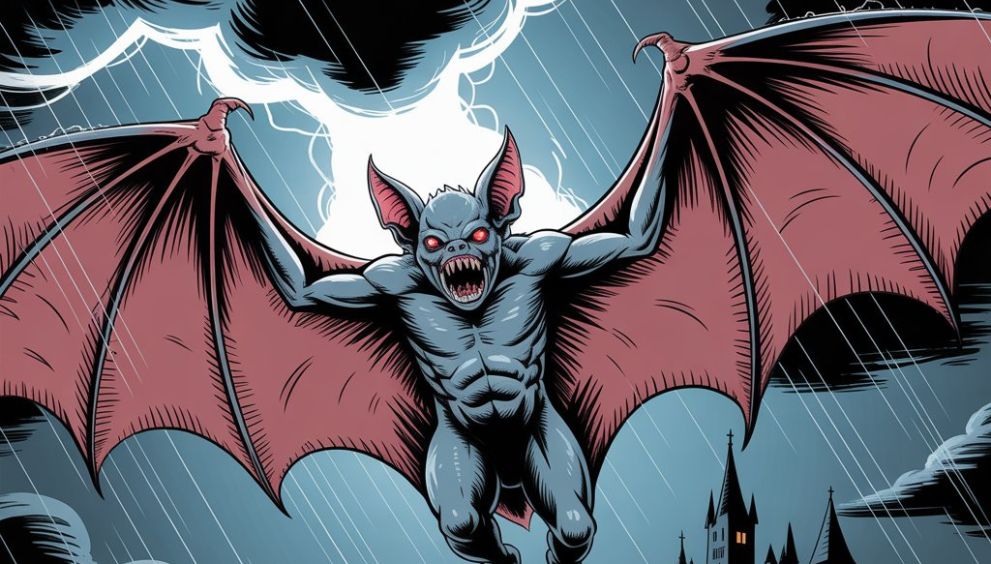
Imagine encountering something that defies everything you know about the natural world. Eyewitness accounts describe the Orang Bati as a truly unsettling sight:
- Standing 4-5 feet tall with an eerily human-like posture
- Blood-red skin that seems to glow in the moonlight
- Massive black, leathery wings spanning wider than a grown man’s outstretched arms
- A long, fur-covered tail that whips behind it as it moves
- A primate-like face that’s disturbingly familiar yet completely alien
The creature’s appearance is so bizarre that it seems pulled straight from a horror novelist’s imagination. Yet for the people of Seram, this isn’t fiction – it’s a reality they’ve lived with for generations.
The Terror of Mount Kairatu
According to local folklore, the Orang Bati doesn’t just randomly appear. It has a home – the caves and crevices of Mount Kairatu, a dormant volcano that looms over the island like a sleeping giant. During the day, the creature allegedly retreats to these dark, underground lairs, waiting for nightfall to begin its horrifying work.
But what makes this creature truly terrifying isn’t just its appearance – it’s what it’s accused of doing. Village elders tell stories of the Orang Bati swooping down in the dead of night to snatch infants and small children from their beds, carrying them back to its mountain lair where… well, the stories become too dark to continue.
The sound of its arrival is said to be unmistakable – a shrill, piercing wail that echoes across the island, warning parents to lock their doors and hold their children close.
A Missionary’s Shocking Revelation
One of the most compelling aspects of the Orang Bati legend comes from an unexpected source: Tyson Hughes, an English missionary who arrived on Seram in 1987. Hughes initially approached the local stories with the skepticism you’d expect from an educated Westerner. These were obviously just primitive superstitions, right?
But something changed during his 18-month stay on the island. The man who had dismissed the Orang Bati as folklore eventually became one of its most convinced believers. Hughes later claimed to have had his own encounter with the creature – a revelation that sent shockwaves through the small community of cryptozoology enthusiasts who heard his story.
What’s particularly striking about Hughes’ account is his transformation from skeptic to believer. This wasn’t someone predisposed to believing in monsters – this was a missionary with a practical mission who found himself face-to-face with something that challenged everything he thought he knew about the natural world.
When Science Meets Legend
The story took an interesting turn when National Geographic Wild decided to investigate these claims for their documentary series “Man v. Monster.” Presenter Richard Terry traveled to Seram to get to the bottom of the Orang Bati mystery, and what he discovered was both fascinating and sobering.
The culprit? Large flying foxes (Pteropus vampyrus) – massive fruit bats that are indeed large enough to be genuinely intimidating. These creatures can have wingspans of up to 5 feet and weigh over 2 pounds. In the darkness, with their fox-like faces and massive wings, it’s easy to see how they could be mistaken for something far more sinister.
But here’s the truly chilling part: while these bats don’t actually steal children, they do carry the deadly Henipavirus. This virus can be transmitted through contact with the bat’s saliva and can indeed kill humans. Suddenly, the villagers’ belief that “people who come into contact with the Orang Bati will die” doesn’t seem so irrational.
More Than Just Mistaken Identity
While the flying fox explanation covers many aspects of the Orang Bati legend, it doesn’t explain everything. The human-like posture, the ability to walk upright, the distinctly primate features – these details suggest that the legend might be more complex than simple misidentification.
Some cryptozoologists have proposed even wilder theories:
- Could it be an unknown species of giant bat with unusually primate-like features?
- Might it be a surviving pterosaur, somehow avoiding extinction for 65 million years?
- Could local tribes have contributed to the legend through their own mysterious practices?
French adventurer Jean Raymond even visited the area in 2005, specifically drawn by the Orang Bati stories. His investigations revealed that there are indeed tribes in eastern Seram who claim the ability to fly and are associated with child abduction stories – adding yet another layer of mystery to an already complex tale.
Living with the Legend
What makes the Orang Bati story so compelling isn’t just the creature itself, but how deeply it’s woven into the fabric of life on Seram Island. This isn’t just an entertaining story told around campfires – it’s a belief system that has influenced behavior, parenting practices, and community life for hundreds of years.
Parents on Seram don’t just tell their children to be home before dark as a general safety measure – they do it because they genuinely fear what might be waiting in those shadows. The sound of large wings overhead isn’t just a bat hunting for fruit – it’s a potential threat that sends families scurrying indoors.
The legend serves multiple purposes: it explains unexplained disappearances, provides a framework for understanding disease and death, and reinforces community bonds through shared fear and protective behavior.
The Enduring Mystery
Today, the Orang Bati remains one of Indonesia’s most enduring cryptid legends. While scientific explanations can account for many of the sightings, the human need for mystery and the unknown ensures that the legend lives on.
Whether you believe the Orang Bati is a misidentified flying fox, an undiscovered species, or something else entirely, one thing is certain: the creature has captured imaginations far beyond the shores of Seram Island. In our age of satellite imagery and DNA analysis, there’s something deeply appealing about a mystery that can’t be easily solved with technology.
The Bigger Picture
The Orang Bati story reflects something profound about human nature – our eternal fascination with the unknown and our need to explain the inexplicable. In a world where disease could strike without warning and children could vanish without trace, the Orang Bati provided both explanation and focus for community fears.
It’s also a reminder that folklore isn’t just entertainment – it’s often rooted in real experiences, real fears, and real observations. The fact that large, potentially dangerous bats do exist on Seram suggests that the legend may have started with genuine encounters, even if those encounters were later embellished and mythologized.
As we continue to explore and explain our world, creatures like the Orang Bati serve as important reminders that mystery still exists, and that sometimes the most rational explanation still leaves room for wonder.
The next time you hear wings flapping overhead in the darkness, you might find yourself thinking of the villagers of Seram Island, and wondering: what if the Orang Bati is more than just a legend? What if, somewhere in those remote Indonesian caves, something truly extraordinary is still waiting to be discovered?
The Orang Bati remains one of cryptozoology’s most intriguing cases – a perfect blend of folklore, genuine animal behavior, and human psychology that continues to captivate researchers and storytellers alike.